By Nury, CEO of Mercadeo Factor
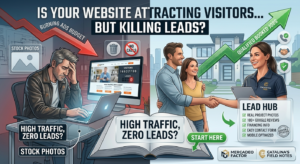
A high-converting corporate website is no longer optional for businesses seeking predictable commercial growth. Let’s be honest: as CEOs, we are constantly shown marketing dashboards painted in beautiful, reassuring shades of green. We see record-breaking click volumes, falling Cost Per Click (CPC) metrics, and reports of rising web traffic. Our marketing teams or agencies present these as triumphs. But when we look at our quarterly balance sheets and compare those digital expenditures with our actual net profit margins and signed commercial contracts, a painful gap emerges.
Our company’s capitalization and growth do not depend on impressions or superficial clicks. They depend on revenue.
For years, we’ve been told that a website is simply a “digital brochure”—a place to display our logo, outline our services, and look modern. That advice is a relic of 2014, and following it is costing us millions in wasted advertising spend and lost opportunities. If your platform isn’t actively pre-qualifying prospects, removing transactional friction, and generating predictable, high-value contracts, it isn’t an asset; it’s an expensive administrative leak.
Here is my straight-to-the-point blueprint on what a high-converting corporate website actually needs to turn digital interest into commercial reality.
1. Stop Measuring Curiosity: Turn Your Site into a High-Converting Corporate Website Engine
The first structural failure in most digital operations is the blind worship of lead volume. Traditional marketing agencies love to boast about a low Cost Per Lead (CPL). They tell us, “We generated 500 leads this month at only $35 each!” As a CEO, that metric alone should make you skeptical. What is the operational friction behind those 500 leads?
If your business development representatives (BDRs) are wasting dozens of hours chasing unvetted contacts, invalid numbers, and low-intent price shoppers, those “cheap” leads are actually draining your resources. If only 5% of those $35 leads turn into an actual contract, your true customer acquisition cost is $700.
Now, compare that to a higher-intent pipeline. Imagine a targeted strategy that generates leads at $120 each, but because these prospects are highly qualified, they close at 30%. Your Cost per Booked Job drops to $400.
A high-converting corporate website must be engineered to capture intent, not curiosity. To stop budget leaks, we must align our digital architecture with our operational sales capacity. Our sites must pre-vet buyers before they ever submit a form. (To evaluate your current performance, explore our Assessment to identify conversion bottlenecks).
2. Fight Analysis Paralysis with Tactical Transparency
One of the deepest psychological barriers in modern B2B and high-ticket B2C transactions is consumer skepticism and price opacity.
Traditional marketers often advise hiding pricing parameters behind a generic, friction-heavy “Contact Us” or “Get a Free Quote” button. They argue that concealing prices forces interaction. In reality, in a fast-moving digital economy, price opacity triggers immediate abandonment. Sophisticated buyers assume that hidden prices indicate either on-site operational inefficiency or an impending high-pressure sales pitch.
To build immediate trust, your high-converting corporate website must offer clear cost frameworks, structural breakdowns, or interactive estimators.
Providing a cost calculator doesn’t mean giving away your gross margins; it means establishing professional, realistic boundaries. When a prospect interacts with an interactive cost estimator on your site, they pre-qualify themselves. If your pricing structure filters out low-tier or unrealistic budget inquiries, your sales team is freed up to focus entirely on closing high-margin commercial contracts. Transparency turns your web presence into an automated vetting system.
3. Prevent the “Mobile Thumb Collapse”
More than 65% of commercial search queries and B2B evaluations now originate on mobile devices. Corporate buyers, facility managers, and busy decision-makers evaluate potential partners on smartphone screens while on the go or directly in the field.
If your website has loading lag, requires pinch-to-zoom navigation, or forces users to fill out a complex, desktop-era 8-field form, they will leave. In UX design, we call this the “mobile thumb collapse.”
The data on this is unforgiving: every additional second of page load latency slashes conversion performance significantly. According to industry studies by Think with Google, mobile users are five times more likely to abandon a task if a site is not fully optimized for speed and user experience.
To combat this, your mobile layout must prioritize “thumb-friendly” interactive modules. Replace single-page, intimidating walls of input fields with clean, multi-step forms that save progress automatically. Incorporate prominent, sticky click-to-call bars and direct calendar integration so a prospect can book a meeting with one tap. Frictionless mobile design is a core operational necessity.
4. The 60-Second Commandment: Speed to Lead
How long does it take your organization to respond to an inbound web inquiry? If your answer is “a few hours” or “by the next business day,” you are actively handing market share to your competitors.
In competitive industries, response speed is the single most critical factor in securing a deal. Key findings in revenue operations research published by Harvard Business Review demonstrate that responding to an inbound lead within minutes drastically increases your close probability compared to delayed responses.
A true high-converting corporate website cannot operate in a vacuum. It must be deeply integrated with your back-end operations, customer relationship management (CRM) systems, and field scheduling software.
When a high-intent prospect submits an inquiry, that action should instantly trigger an automated SMS confirmation, notify your sales team, and prompt an immediate call. By bridging the gap between your front-end web experience and your operational workflow, you eliminate human lag and ensure that no paid demand leaks out of your pipeline.
5. Designing for Humans and Algorithms: AEO Strategies for Your High-Converting Corporate Website
The search landscape is undergoing its most massive evolution since the invention of the web. Modern executives and corporate buyers are no longer wading through pages of blue links on Google. Instead, they are turning to conversational search engines and LLMs—like ChatGPT, Gemini, Perplexity, and Claude—to synthesize information and recommend partners.
To remain visible, your brand must transition from traditional Search Engine Optimization (SEO) to Answer Engine Optimization (AEO).
If your website’s content, technical case studies, and corporate credentials are not structured for easy machine extraction, you will become entirely invisible to the primary recommendation algorithms.
Optimizing a high-converting corporate website for AEO requires structuring your content into clear, direct, and authoritative semantic blocks. You must explicitly answer the exact questions your buyers are asking conversational engines, back your claims with verifiable data, and maintain flawless schema markup. When a decision-maker asks an AI, “Who is the most reliable commercial partner in my region?” your business must be the clear, cited answer.
The Ultimate CEO Mandate: Asset vs. Expense
Every dollar we allocate as leaders must be measured by its return on equity and enterprise value.
If we continue to judge our digital presence by superficial marketing metrics like clicks and traffic, we will continue to suffer from digital budget leaks. True profitability requires us to enforce operational discipline on our marketing spend.
Your digital infrastructure should be your most scalable, consistent, and predictable salesperson. By engineering a high-converting corporate website that prioritizes financial transparency, frictionless mobile interaction, instant operational response, and AI search visibility, you transform your web presence from a recurring administrative expense into a high-yielding corporate asset. (For actionable frameworks, visit our Internal Link: CEO Growth Resources page).
It’s time to stop paying for empty clicks. Let’s build digital architectures that secure real commercial contracts. engineering it to prioritize financial transparency, frictionless mobile interaction, instant operational response, and AI search visibility, you transform your website from a recurring administrative expense into a high-yielding corporate asset.
It’s time to stop paying for empty clicks. Let’s build digital architectures that secure real commercial contracts.